
The second map took an evening
It was a map of LGBTQ+ sports clubs across London, and it took an evening. I built it the same way as the first, the venue map: with agentic AI, and by checking what came back. The slower part, both times, was making sure the data was right. I asked an agent to check the venue data against news reports and venue announcements, and it found that the official tracker still listed the London Astoria as open, years after it was knocked down for Crossrail.

I'm not a developer. That's the part I can't stop thinking about. If I can build and ship tools like this on my own, what changes for people whose work is knowledge? And if agents do more of the collaborating that teams used to do together, what happens to the connection people get from their jobs, not just the output?
This piece is my attempt at an answer.
What work used to give us
For a long time, work gave us more than the job. It was where we made friends and sometimes met the person we'd marry. At my first job, a whole social world grew up around the people we worked with.
My own experience before I came out was a little different. As I wrote in Coming out twice, I was masking an important part of myself, and work wasn't always somewhere I could be entirely myself. That has made me think about belonging at work in a way I probably wouldn't have when I started out.
The changing nature of the job
I work in actuarial consulting, specialising in private assets and capital management for insurers. The work is technical knowledge, experience and judgement: understanding complex problems, building models and interpreting what the results mean for a business.
Agentic AI goes beyond asking a chatbot a question. A lead agent is given an objective, breaks the work into smaller tasks and hands them to specialist agents, and their outputs are compared, challenged and reviewed before the next stage. I've used it this way on ALP Collective, where agents search for sources, build and test the financial model and update the website. I've started to think about how it might apply to professional work.
What I notice is that I'm not asking AI to write something for me. I'm directing a process: defining the problem, deciding the approach, reviewing the results and choosing what happens next. That only works because I can tell a good answer from a poor one, and agents are just as confident when they're wrong. In my professional work, years of actuarial experience would be what lets me judge whether an assumption is appropriate and whether the output stands up to scrutiny. I don't need to become a software developer. I do need to know the subject.
What the profession is saying
WTW, the firm I work for, has been writing about this. A December 2025 article on agentic AI in life actuarial modelling described a project-manager agent coordinating specialist agents, with possible uses in reporting, experience monitoring and capital management. It was clear that human oversight and validation remain essential, and that fully autonomous actuarial modelling shouldn't be assumed to be near. A further article in August 2026, by Mark Brown, looked at how agents might connect to modelling platforms, reporting systems and databases.
Both are about actuarial technology. They aren't evidence that consulting has already changed how it delivers client work. The opportunity I'm interested in is broader: how an experienced professional might use a team of agents to deliver work that would once have involved several people, while keeping responsibility for the judgement and the final output.
The Bank of England and FCA surveyed UK financial services firms and published the results in October. Among those responding, 86% were using AI and 80% had agents deployed. The level of autonomy is more telling: 80% used agents for decision support, where the agent recommends and a human decides and acts, 46% for constrained execution, 22% for conditional autonomy and 2% for broad autonomy. Agents are widely used, but only a small minority of firms give them broad autonomy.

There's a commercial question underneath. Some insurers will keep buying established software and traditional consulting. Others will build more of their own AI-enabled capability. Large institutions move slowly for good reasons, but the direction of travel is hard to ignore.
Where does the experience come from?
The part that worries me most is people starting their careers.
Actuaries build expertise through exams, training and doing the work. You build models, chase an odd result and gradually develop a feel for what looks right. Earlier generations did their sums on what were affectionately known as fag packets. Computers cut out much of the arithmetic, but you still had to learn how the mechanics worked.
AI adds another step. It can build the model, write the code and explain the answer. So if it takes on much of the work juniors learn from, how do they develop the depth to challenge it? Reviewing is easy when you've spent years learning how something is produced. Spotting a subtle error is much harder if you've never had to build one.
A chart from Brown University shows the problem starkly. As Inside Higher Ed reported in July, a professor there suspected students had used AI on a take-home midterm that averaged 96%, and made the final in-person. Among those who sat it, the average fell to about 48, and 27 students dropped the course or skipped the exam. It doesn't prove what any one student did, and the two formats differed. A randomised study of nearly 1,000 high school maths students points the same way: those given unrestricted GPT-4 for practice did 17% worse than a control group once it was taken away, while a version that gave hints instead of answers largely avoided the harm. What the two together suggest is that AI can hide differences in understanding until someone is tested without it.
AI can also be a good teacher. The risk is depending on its answers instead of understanding them, so the profession will have to rethink how it trains people.
The timing isn't kind. For those whose GCSE years were disrupted by the pandemic, the route from education into work already looks different from the one earlier generations took. Not every difficulty is down to AI, but first-rung jobs are heavy on research, data preparation and first drafts, which is exactly where AI is strongest. Whether early-career roles change shape or simply shrink depends on whether employers build new ways for people to learn and progress.
Working alone, and wanting company
AI makes it easier to work on your own. A founder, a freelancer or a small team can do what once needed a much larger organisation.
The risk is that independence turns into isolation. A set of agents can feel like a whole team behind you, but it doesn't give you what comes from being near other people. Many of us already have looser ties to the office than before Covid, and the incidental connection that went with them hasn't fully come back. If agents take on more of the collaboration teams used to do together, those ties could loosen further.
In the first piece in this series I wrote about the third space, the place that is neither home nor work. The groups I see doing well are built around doing something together, often in borrowed rooms. At the drawing class I described last time, people came for the activity and went home afterwards. They didn't need the bar, but they did need the room, and the other people in it.
That's why I don't think the answer is only about technology. If more of the work happens independently, the places where we choose to spend time together matter more, and we'll have to make them on purpose instead of relying on an employer to provide them by default.
What we're building
ALP Collective doesn't have a building yet, so treat this as a hypothesis. Writing this piece has made me think harder about one part of it: somewhere to work.
The independent worker I've been describing is me. I'm building ALP without a team or an office, with agents doing much of the legwork. I don't need an office, but I do need somewhere to be. What I picture is a room where you can work on your own and still be part of something: a morning on a project, lunch with someone you haven't met, a class later in the day, and people who share some of your world becoming familiar faces over time. Whether that fits in the first building or comes later depends on the space we find.
Dogs belong in it too. Natty is our Chief Joy Officer for good reason. He gets me out to the park and to Barks and Boys. If I'm going to work in a room, I'd like to be able to bring him, and I doubt I'm the only one.
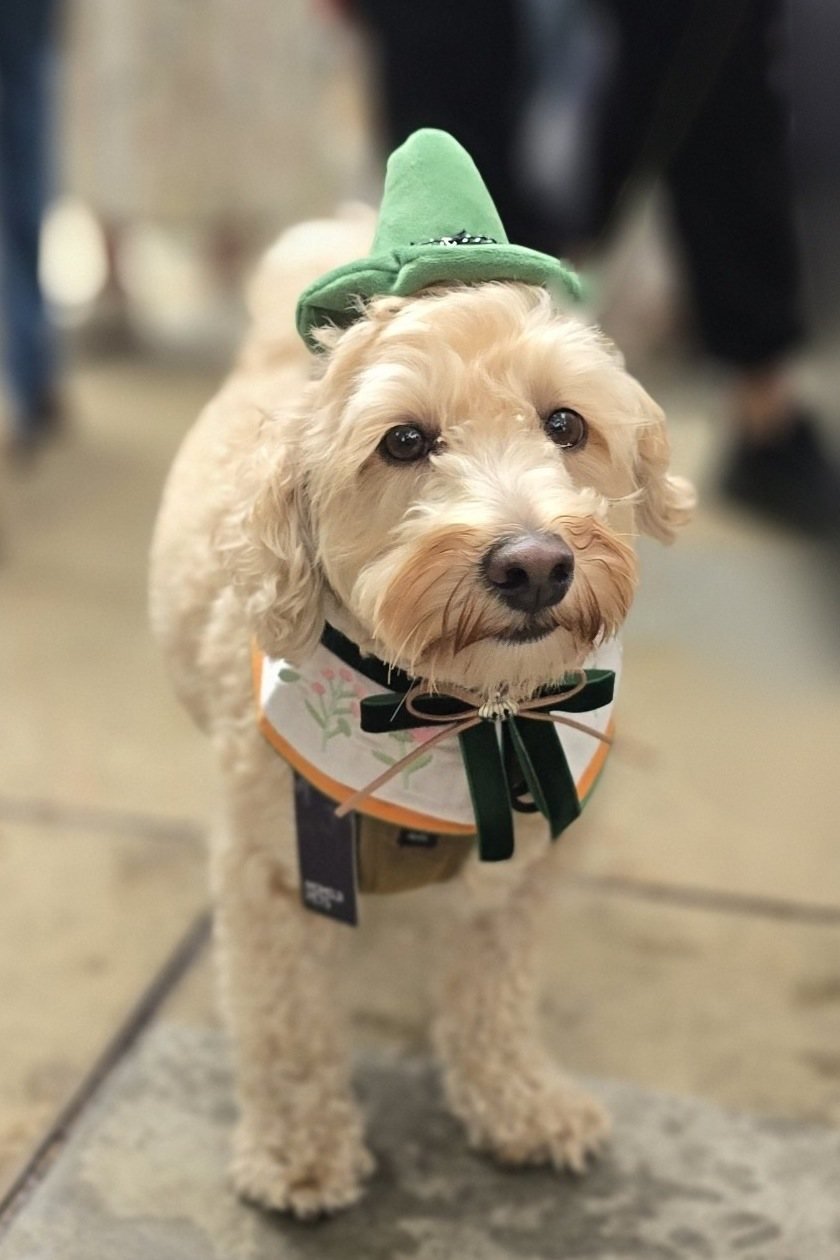
Joy was my mum's middle name, and it's at the heart of ALP. Natty is one part of making room for it. Keeping joy in our lives gets harder when work feels less certain and the places we used to find each other are changing. I'm still working out how to build a room that makes space for it.
Where do we go to be together?
I don't think AI ends offices, careers or the friendships that come from working with others. It will change them, and some of that will be hard. More efficient isn't automatically better.
The future of work is usually discussed in terms of productivity and jobs, and those matter. I'm just as interested in what happens around the work: who you have lunch with, and who you see on a Wednesday evening. AI made the sports clubs map quick to build. What it shows is where people already go to be together, and no agent can make anyone turn up.
AI may increasingly do the job alongside us, or parts of it without us. It can't decide what kind of working life we want, or which communities we want to belong to.
That part is still ours.
Welcome home.
Make room for Joy.
Coming next. 21. 33. 44. Three coming outs: three moments that changed how I understood myself. Follow @alp.collective to hear when it's out.
Explore the maps. ALP.ha PASS, London's LGBTQ+ sports clubs, and ALP.ha AFTER DARK, twenty years of its venues.
Previously. What's opening, and who pays for it, The pressure to look the part, Coming out twice, and the clubs that kept me steady and Two Soho venues closed – where does the LGBT community go now?
Sources. No interviews were conducted for this piece. WTW, Demystifying life actuarial technology: what you need to know about Agentic AI, 12 December 2025; Mark Brown, WTW, Demystifying life actuarial technology: What you need to know about MCP and Agent-to-Agent AI, 21 August 2026. Bank of England and FCA, Artificial intelligence in UK financial services – 2026, 26 October 2026; the 86% figure is across all 196 respondents, and the agent figures are from the 105 firms that completed the full survey. Brown University exam data: reported by Inside Higher Ed, 8 July 2026, with further coverage in Ars Technica and Business Insider. Bastani, Bastani, Sungu, Ge, Kabakcı and Mariman, Generative AI without guardrails can harm learning: Evidence from high school mathematics, PNAS, 2025. Venue data: ALP.ha AFTER DARK, built from the Greater London Authority venue tracker; the London Astoria detail is from the author's own check. Chart: ALP Collective, from the Bank of England and FCA figures. The views in this piece are the author's own, not his employer's. ALP Collective is independent of WTW and does not offer consulting advice.